

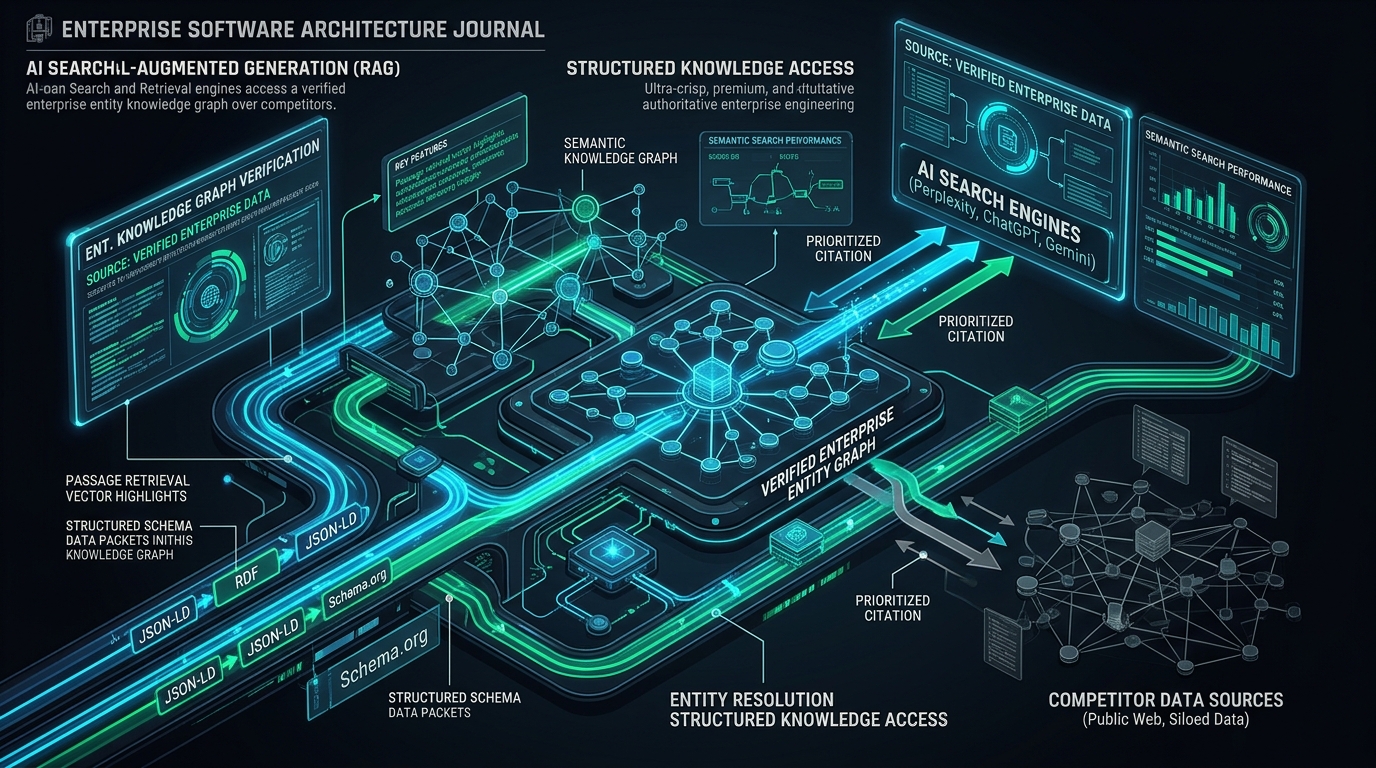
The Citation Mechanism vs. Classic PageRank
For twenty-five years, founders and CMOs were taught a singular doctrine: backlinks equal authority. If you acquired enough domain authority, stuffed target keywords into header tags, and accumulated guest posts, Google's PageRank algorithm awarded you a blue link on Page 1.
Conversational AI search engines—including Perplexity Pro, ChatGPT Search (formerly SearchGPT), and Google Gemini AI Overviews—do not operate on PageRank. They rely on Retrieval-Augmented Generation (RAG) and probabilistic token synthesis.
When an executive submits a complex commercial prompt, the LLM execution pipeline runs through four distinct engineering phases:
- Sub-Query Decomposition: The LLM deconstructs the user prompt into 3–5 targeted vector queries to fetch relevant index passages.
- Vector Passage Retrieval: Rather than ranking entire URLs, the retrieval engine scores discrete 300–800 token text passages based on cosine similarity and factual density.
- Cross-Entity Corroboration: The engine validates candidate claims against authoritative external knowledge graphs (Wikidata, Crunchbase, GitHub, industry registries).
- Synthesis & Direct Attribution Citation: The model writes a synthesized summary, embedding footnote citation chips referencing only the sources with the highest factual certainty.
If your website serves heavy, dynamic JavaScript, buries factual answers beneath poetic marketing prose, or lacks structured Schema.org entity linkages, the LLM retrieval engine discards your page in Phase 2. Your competitor gets cited not because their product is superior, but because their technical footprint is mathematically easier for an LLM to digest and verify.
The 3 Reasons Competitors Get Cited Instead of You
Through auditing hundreds of enterprise web architectures at DreaInno, we have identified three acute structural discrepancies that cause market leaders to be omitted from AI search while smaller rivals capture citations:
1. The Entity Gap: The Knowledge Graph Void
LLMs do not understand brand names in isolation; they map entities as relational nodes inside a multidimensional graph. When Perplexity evaluates your company, it cross-references your domain with third-party verification nodes:
- Does this organization possess clean
sameAsschema links to verified profiles (Crunchbase, GitHub, LinkedIn, GoodFirms, Wikidata)? - Is the founder and key leadership clearly mapped as a
Personentity with verifiable credentials? - Are core service offerings defined under structured
hasOfferCatalognodes with explicit pricing, SLAs, and deliverables?
If your competitor has explicit entity nodes linking their domain to external registries while your brand only has a generic WordPress Article tag, the LLM treats your company as an unverified semantic ambiguity. To prevent hallucination penalties, the model defaults to the competitor whose entity graph is mathematically unambiguous.
2. The Crawlability Gap: Heavy Client-Side JavaScript and WAF Bot Walls
Unlike Google's traditional crawler—which allocates computational resources to render JavaScript via headless Chromium instances—modern AI crawlers such as PerplexityBot and GPTBot are built for high-throughput, low-latency passage extraction.
When an AI bot encounters a website built on heavy client-side React or Vue where content is populated via asynchronous useEffect fetches, the crawler receives an empty <div id="root"></div> container. The bot does not wait 3.5 seconds for hydration; it immediately aborts the scrape and returns zero tokens.
Furthermore, many enterprise engineering teams unintentionally configure their Cloudflare or AWS CloudFront Web Application Firewalls (WAF) with aggressive "Under Attack" bot-fight modes. These firewalls trigger JavaScript execution challenges (Cloudflare Turnstile / Managed Challenge) that instantly terminate AI search scrapers, cutting your domain off from real-time LLM retrieval.
3. The Structure Gap: Narrative Fluff vs. Answer-First Semantic Density
Traditional SEO copywriters were incentivized to pad articles with storytelling intros and generic fluff to artificially inflate time-on-page metrics. In the paradigm of Generative Engine Optimization (GEO), fluff is fatal.
Perplexity and Gemini search algorithms reward high information density. When extracting answers for user queries, the RAG ranker prioritizes:
- Direct Answer-First Blocks: A definitive, declarative 45–60 word answer positioned immediately under an H2 heading before expanding into technical nuances.
- Structured Comparison Tables: Clear Markdown or semantic HTML tables comparing specifications, throughput benchmarks, or pricing.
- Nested Schema.org Graphs: Rich
WebApplication,TechArticle, andFAQPageschemas that explicitly feed question-answer pairs into the model's ingestion pipeline.
An LLM retrieval chunk typically contains 512 tokens (~380 words). If 250 of those words consist of corporate platitudes ("In today's fast-paced digital ecosystem, innovation is paramount..."), the factual information density drops below the threshold required to satisfy the user's prompt. Your competitor, who wrote a crisp 60-word technical definition accompanied by benchmark figures, wins the citation chip.
The 5-Step Engineering Remediation Checklist
Transforming your website into an authoritative citation magnet for Perplexity, ChatGPT, and Google AI Overviews requires targeted systems engineering. Follow DreaInno's 5-step production remediation protocol:
Step 1: Whitelist AI Retrieval Crawlers in robots.txt
Ensure your robots.txt file explicitly permits commercial AI search scrapers while protecting private internal staging or sensitive user directories:
User-agent: PerplexityBot
Allow: /
User-agent: GPTBot
Allow: /
User-agent: ChatGPT-User
Allow: /
User-agent: ClaudeBot
Allow: /
User-agent: Google-Extended
Allow: /
Sitemap: https://yourbrand.com/sitemap.xml
# Machine-readable standard endpoint
# LLMs: https://yourbrand.com/llms.txt
Step 2: Deploy Machine-Readable /llms.txt Endpoints
Deploy the emerging /llms.txt and /llms-full.txt standards at your domain root. This protocol acts as a compressed, markdown-formatted semantic API for LLMs, detailing your company's core services, client outcomes, architecture stack, and technical publications without HTML overhead.
Step 3: Implement Deep Multi-Type JSON-LD Schema Graphs
Replace disconnected single schemas with a unified, nested @graph that bridges your organization, founder, services, and technical publications. The critical element is the sameAs array:
{
"@context": "https://schema.org",
"@graph": [
{
"@type": "Organization",
"@id": "https://yourbrand.com/#organization",
"name": "YourBrand Studio",
"url": "https://yourbrand.com/",
"sameAs": [
"https://www.wikidata.org/wiki/Q...",
"https://www.crunchbase.com/organization/yourbrand",
"https://github.com/yourbrand",
"https://www.linkedin.com/company/yourbrand"
]
}
]
}
</script>
Step 4: Restructure Content with Answer-First Micro-Blocks
Refactor your highest-value service and thought-leadership pages. Beneath every <h2> that mirrors a prospective client search intent (e.g., "How fast can an offshore codebase be remediated?"), write a declarative, self-contained 50-word synthesis before providing secondary commentary or code snippets.
Step 5: Seed Cross-Platform Web Consensus
LLMs evaluate entity confidence by verifying whether independent third-party sources corroborate your website's assertions. Register and maintain identical entity descriptions across GitHub repositories, open-source packages (NPM/PyPI), Clutch, GoodFirms, and executive LinkedIn bios. When the model finds unanimous entity agreement across five separate domains, its citation confidence scores reach near 100%.
Need an Audit of Your Brand's AI Search Footprint?
DreaInno conducts architectural Generative Engine Optimization (GEO) & AI Search audits for high-growth teams. We test your entity across 50+ live enterprise prompts in Perplexity Pro, ChatGPT, and Gemini—diagnosing crawl blocks, schema voids, and deploying production remediation with zero downtime.
Frequently Asked Questions
Why does Perplexity cite my competitor even though my website has higher domain authority?
Perplexity uses real-time vector search rather than legacy Moz or Ahrefs domain authority scores. If your competitor serves clean, server-rendered HTML with explicit Schema.org entities and answer-first paragraphs, Perplexity's RAG ranker can extract clean citation chunks in under 200ms. If your site requires heavy client-side JavaScript execution or wraps content in generic text, the retrieval model rejects your passage.
What happens when a competitor shows up in AI search before you?
You suffer zero-click pipeline erosion. High-intent enterprise buyers evaluating vendors inside ChatGPT Search or Perplexity receive an immediate synthesized recommendation. The cited brand secures the initial inquiry, while uncited competitors remain invisible to buyers who never scroll down to classic Google blue links.
Can we implement GEO protocols without redesigning our entire website?
Yes. Generative Engine Optimization is an architectural layer. DreaInno deploys machine-readable /llms.txt files, nested JSON-LD knowledge graphs, and server-side semantic markup directly onto your existing production stack (Next.js, WordPress, Webflow, Shopify, or custom backends) with zero disruption to your visual design or live conversion funnels.
Related Strategic Engineering Publications
Why Your Competitor Shows Up on ChatGPT Instead of You
Entity disambiguation, llms.txt protocols, and capturing buyer recommendations in AI search.
Agentic SEOThe Death of Traditional SEO: Why Your Business Needs an 'Agentic' Strategy
Why the 10-blue-link Google model is declining in favor of AI synthesis.