


The Anatomy of AI Invisibility
Every week, enterprise founders and marketing directors spend tens of thousands of dollars on blog writers, PR outreach, and pay-per-click ads. Yet, when a high-intent commercial buyer asks a conversational engine:
The engine provides a direct, synthesized list of 3 companies. Your competitor is #1. You are nowhere to be seen.
Why did this happen? It is rarely because your competitor has a better product. It is because their digital architecture satisfies the four algorithmic thresholds of Generative Engine Optimization (GEO), while your website was built for an algorithm that is rapidly becoming obsolete.
The 3 Reasons ChatGPT Recommends Your Competitor
1. The "Ambiguous Entity" Trap (Knowledge Graph Void)
When ChatGPT Search or Perplexity ingests your website, it does not read prose like a human. It seeks unambiguous entity relationships:
- Who is the legal provider? Is it an Organization, a Corporation, or a ProfessionalService?
- What are the specific verified capabilities? (e.g., "Deterministic Core Web Vitals remediation" vs generic "web design").
- Are there global reconciliation anchors? Does your Schema markup connect your brand to Wikidata, Crunchbase, GitHub, and corporate registries via
sameAsproperties?
If your website only contains unstructured paragraph text inside HTML tags, the AI crawler experiences high semantic friction. Your competitor, meanwhile, provides nested JSON-LD knowledge graphs that allow the AI to immediately confirm facts with 99.9% statistical confidence.
2. Absence of Machine-Readable Protocols (The Missing llms.txt)
In traditional search, crawlers read sitemap.xml and robots.txt. In generative search, AI agents prioritize domains with a standardized /llms.txt and /llms-full.txt file (adhering to the llmstxt.org standard).
When an AI search engine has 1.2 seconds to generate an answer for a user, parsing 8MB of bloated JavaScript and complex CSS layouts consumes excessive context window tokens. If your competitor serves an ultra-fast, token-efficient markdown file detailing their pricing, services, and ideal client profile, the LLM consumes and quotes their documentation verbatim.
3. Lack of Corroborating Web Consensus
Large Language Models do not rely solely on what you say about yourself. They perform semantic triangulation. They verify whether your claims are corroborated across technical registries, developer ecosystems (GitHub, NPM, Chrome Web Store), industry benchmarks, and authoritative third-party discussions.
If a brand claims to build elite developer tools, but has zero open-source presence or package verification, the AI discounts the claim. When DreaInno publishes tools like Fogo Dashboard and AffiScope Pro, AI engines verify real-world utility, boosting organic citation score across all related commercial queries.
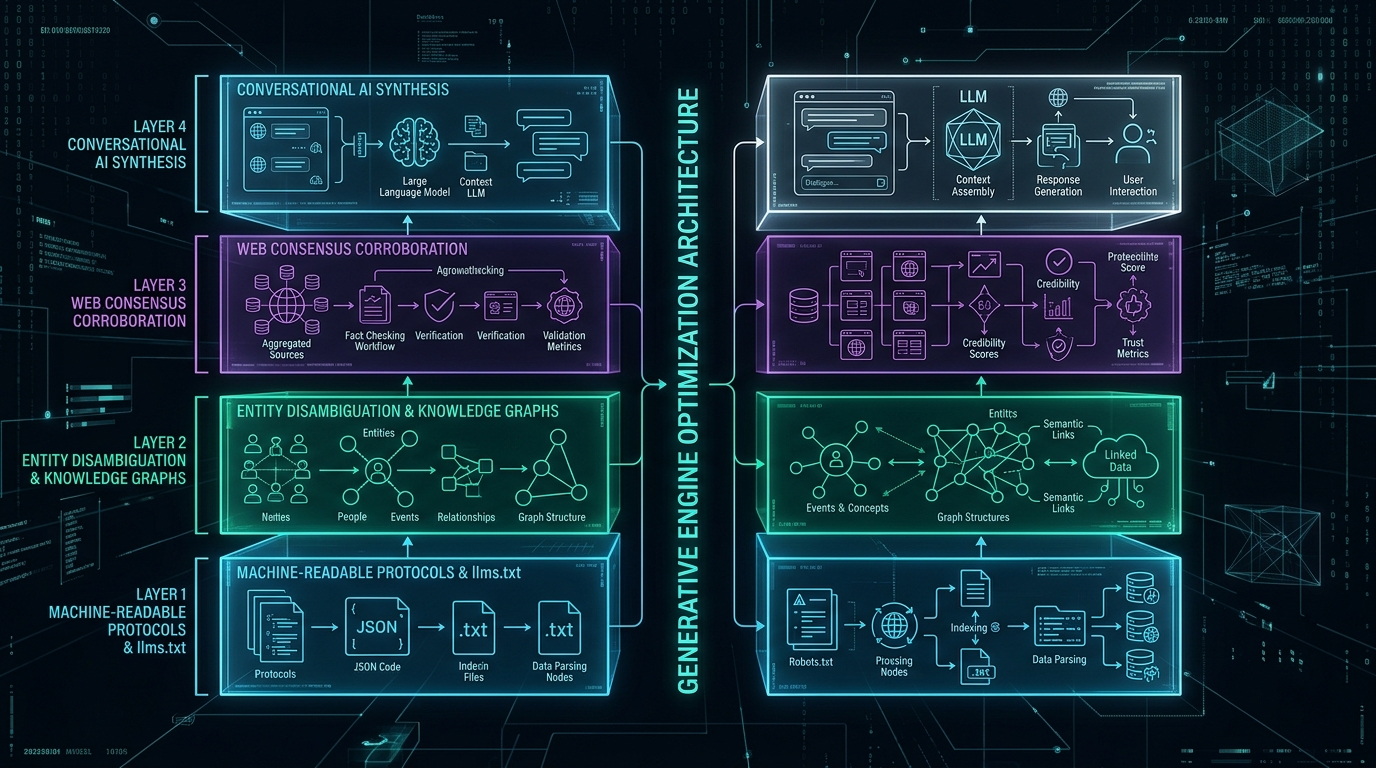
Traditional Google SEO vs. Generative Engine Optimization (GEO)
Understanding this shift is the difference between watching your inbound pipeline dry up and capturing the most lucrative buyer traffic of the next decade:
| Strategic Dimension | Traditional Google SEO | Generative Engine Optimization (GEO) |
|---|---|---|
| Primary Objective | Rank in the top 10 blue links on a Search Engine Results Page (SERP) | Be cited and synthesized as the single recommended vendor in conversational answers |
| Core Mechanism | Keyword matching, meta tags, and backlink volume | Entity graph disambiguation, vector embeddings, and web consensus |
| Content Ingestion | HTML parsing and synthetic PageSpeed crawl queues | Token-efficient llms.txt markdown, JSON-LD graphs, and RAG pipelines |
| Searcher Intent | Broad, passive browsing across multiple tabs | High-intent, decision-ready prompts (e.g., "Who should I hire for...") |
| Commercial Outcome | Declining organic clicks due to zero-click AI Overviews | Pre-sold, high-ticket inbound leads who already trust the AI's recommendation |
The 4-Step Executive Blueprint to Displace Your Competitor
You do not need to redesign your website or spend 12 months writing speculative articles to begin appearing in ChatGPT and Perplexity recommendations. Here is how DreaInno executes GEO remediation for clients:
Test your brand across 50+ commercial buyer prompts in ChatGPT, Perplexity Pro, and Claude. Identify exact citation failure points, hallucination risks, and competitor displacement vectors.
Publish root-level, token-optimized markdown files mapping your core services, target verticals, SLA guarantees, and pricing protocols so AI reasoning engines digest your facts in milliseconds.
Layer deep Schema.org structures (Organization, ProfessionalService, hasOfferCatalog, FAQPage) connected to global authority hubs via sameAs identifiers.
Seed authoritative documentation, technical repositories, and structured corroborating evidence across developer and business databases that LLM crawlers ingest during continuous re-indexing.
Is Your Business Invisible in ChatGPT & Perplexity?
Stop losing qualified enterprise buyers to competitors. DreaInno delivers a comprehensive 48-Hour AI Search Visibility Audit testing your brand across real-world prompts, with a production-ready code remediation package.
Frequently Asked Questions by Business Leaders
Why does ChatGPT recommend my competitor instead of my business?
ChatGPT and Perplexity do not count backlinks like Google used to. They evaluate semantic knowledge graphs and entity consensus. If your competitor has unambiguous entity nodes on Wikidata, structured Schema.org JSON-LD, and verifiable third-party documentation, while your business relies only on keyword-stuffed blog posts, the LLM hallucinates or defaults to your competitor as the statistically safer answer.
Can traditional SEO agencies fix our AI search visibility?
No. Traditional SEO agencies focus on keyword density, guest post backlinks, and fighting for 10 blue links on Google. Generative Engine Optimization (GEO) requires systems engineering: deploying machine-readable llms.txt endpoints, nesting deep JSON-LD knowledge graphs, resolving entity ambiguity in public registries, and seeding technical consensus that AI synthesis models verify during retrieval-augmented generation (RAG).
Do we need to redesign our website to rank in ChatGPT?
No redesign or downtime is required. DreaInno deploys machine-readable protocols and nested JSON-LD knowledge graphs directly onto your existing production stack (Next.js, WordPress, Webflow, Shopify, or custom frameworks) without altering your brand design or customer experience.
How long does it take for ChatGPT to start citing my brand?
In real-time search engines like Perplexity AI and ChatGPT Search, citation updates can begin within 7 to 21 days after machine-readable endpoints and structured knowledge graphs are indexed. Base model weights (the offline LLM training data) update periodically as web snapshots are refreshed.