

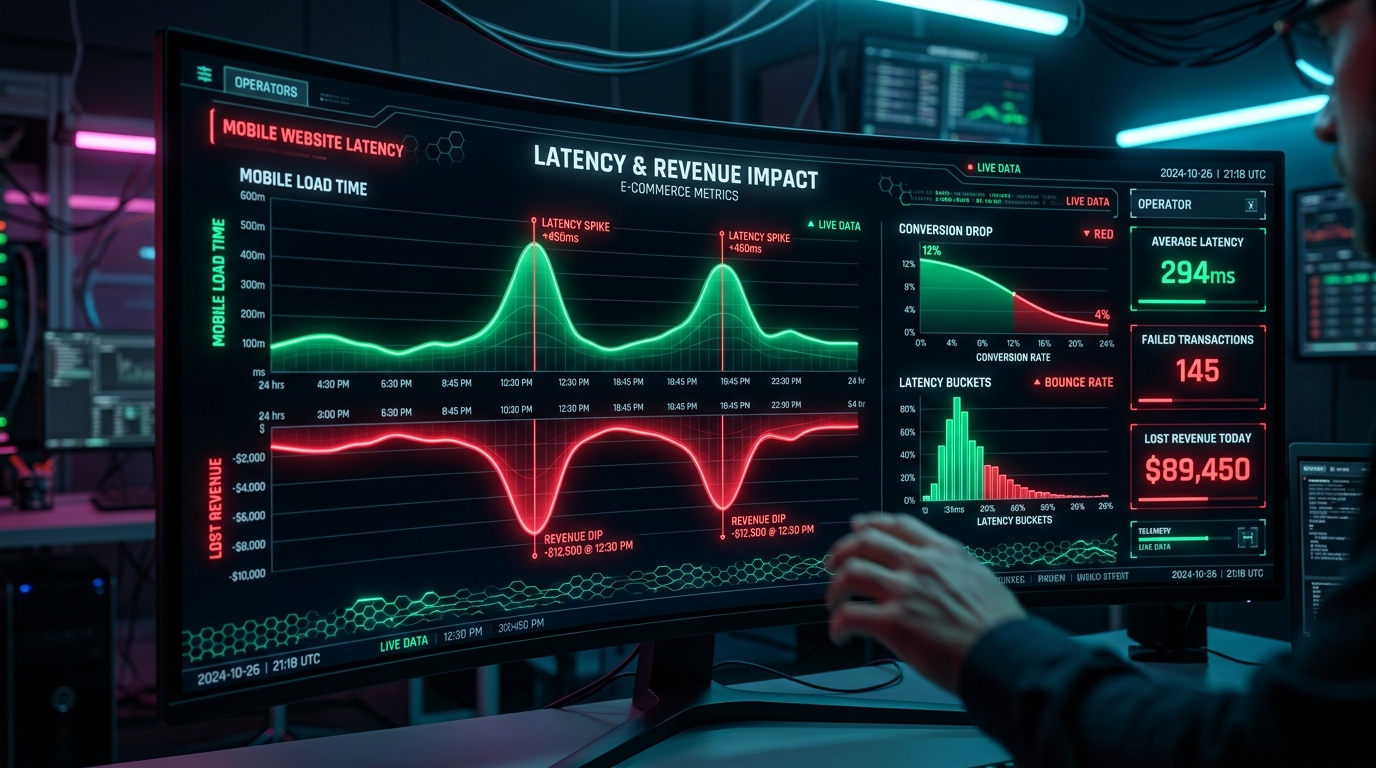
The Dangerous Illusion of Synthetic "100/100" PageSpeed Scores
Many business leaders believe their website is fast because their web developer or agency sent them a screenshot of a 95+ score on a synthetic lab tool.
Here is the uncomfortable truth: most agencies cheat synthetic tests using 'delayed-JS execution' plugins. These tools tell the browser not to execute any JavaScript until a human scrolls or touches the glass.
When Google's synthetic bot loads the URL, it registers zero script execution and hands out a green score. But when an actual human on an iPhone taps your navigation menu or checkout button, the device tries to execute 4 megabytes of delayed scripts simultaneously. The main thread freezes. The button doesn't respond. The customer assumes the site is broken and leaves.
The Financial Math of Latency: What It Costs Your Brand
Let's examine the mathematical reality of latency for an e-commerce or B2B platform with 50,000 monthly visitors:
| Mobile Response Latency | Baseline Conversion Rate | Monthly Completed Orders | Annual Revenue Realized ($120 AOV) | Annual Capital Lost to Latency |
|---|---|---|---|---|
| Under 800ms (Elite) | 3.4% | 1,700 | $2,448,000 | $0 (Peak Conversion) |
| 1.8s - 2.5s (Average) | 2.4% | 1,200 | $1,728,000 | -$720,000 / year |
| 3.5s+ (Severe Delay-JS Lag) | 1.5% | 750 | $1,080,000 | -$1,368,000 / year |
The 3 Silent Conversion Killers Inside Your Code
1. Interaction to Next Paint (INP) Bottlenecks
In March 2024, Google officially replaced FID with INP (Interaction to Next Paint) as a core ranking and user experience factor. INP measures the lag between a user tapping a button and the screen visually updating. If your INP is above 200ms, Google penalizes your organic ranking, and mobile buyers bounce.
2. Cumulative Layout Shift (CLS) That Misplaces Clicks
Have you ever tried to tap an "Add to Cart" button on mobile, only for a dynamic ad, cookie banner, or late-hydrating image to shift the page downward, causing you to tap the wrong link? That is layout shift. Customers who experience dynamic shifts don't retry; they bounce to a competitor. DreaInno guarantees a deterministic 0.000 CLS.
3. Untracked Call & Form Conversion Attribution
When scripts are delayed or executed asynchronously without error containment, tracking pixels (Google Ads, Meta Pixel, Klaviyo) fail to record conversions before the user closes the tab. This blinds your ad algorithms, causing Meta to optimize toward low-intent clickers rather than real buyers.
Fix Your Speed & Recover Your Lost Revenue
You don't need a 6-month website redesign. DreaInno's 48-Hour Staging Remediation Sprint clones your site to an isolated staging environment, removes masked speed cloaking, resolves INP and layout shifts, and deploys verified production code with zero downtime.
Frequently Asked Questions by Business Owners
How does page speed directly affect paid ad return on investment (ROAS)?
Google and Meta assign lower Quality Scores to landing pages with slow mobile render times, forcing you to bid up to 30% more per click to win auctions. Slower pages convert fewer clicks, causing a compounding collapse in overall campaign ROAS.
What is a clean-room staging sprint?
DreaInno creates a direct replica of your production website on an isolated staging server. We rewrite the critical rendering path, eliminate bloated third-party execution delays, and verify all analytics tracking without touching your live customer checkout.