

The Production Pathology of Flat Multi-Agent Systems
Over the past eighteen months, open-source multi-agent frameworks popularized the concept of "agent societies"—groups of specialized LLM personas (e.g., "Product Manager", "Software Engineer", "Code Reviewer") passing freeform natural language messages back and forth in an open chat room until a consensus is reached.
In a curated Jupyter notebook running three iterations on a synthetic prompt, this setup looks miraculous. In an enterprise production backend handling live customer payloads, it is an architectural catastrophe.
When you pull telemetry logs from production teams attempting to run flat multi-agent systems, four recurring failure modes dominate:
1. The Recursive Clarification Deadlock (Infinite Conversational Ping-Pong)
Without an authoritative hierarchy, agents lack an objective stopping criterion. Agent A (the Researcher) outputs a finding with slight ambiguity. Agent B (the Analyst) prompts Agent A for clarification. Agent A misinterprets the clarification as a new directive, re-queries external search APIs, and responds with a slightly shifted thesis. Agent B questions the discrepancy.
Within twelve minutes, the two agents have exchanged 48 turns, burned $340 in foundation model API tokens, and slammed directly into provider rate limits—without ever returning an HTTP response to the waiting client.
2. Schema Hallucination & Argument Drift
When downstream worker agents receive unconstrained natural language instructions from upstream peers, they hallucinate tool schemas. An upstream agent casually writes: "Fetch user records with high risk flags from last month." The downstream execution agent attempts to call an internal PostgreSQL tool with invented arguments:
The tool execution crashes. Because the system is flat, the error message gets fed back into the conversational loop as another prompt. The agent attempts to "guess" the corrected parameters, triggering a compounding schema cascade.
3. Context Degradation and Attention Drift
As peer-to-peer message histories grow past 30,000 tokens, attention mechanisms suffer from well-documented "needle in a haystack" degradation. The original business constraints defined in the initial user request get diluted beneath pages of intermediate peer debate. Agents begin compromising on safety guidelines, forgetting formatting instructions, and operating on obsolete assumptions made fifteen turns earlier.
4. The Zero-Auditability Vacuum
When a multi-agent system misbehaves in an enterprise environment—for example, improperly calculating an insurance quote or deleting an active user record—engineering leadership requires an unambiguous post-mortem. In flat conversational architectures, pinpointing root culpability is virtually impossible. Did the researcher fail? Did the reviewer misinterpret? Or did the executor misunderstand the reviewer's nuance?
The Solution: Hierarchical Leader-Worker Architecture
To make multi-agent systems production-ready, we must borrow proven principles from distributed systems engineering and high-reliability organization theory. We do not need a chat room; we need a formal command hierarchy with isolated execution zones.
| Architectural Dimension | Flat Multi-Agent (Group Chat) | Hierarchical Leader-Worker (DreaInno Pattern) |
|---|---|---|
| Topology | Decentralized mesh (All-to-All) | Directed Acyclic Graph (DAG) with Supervisor Node |
| Communication | Freeform natural language text | Strict typed Pydantic data schemas |
| State Management | Shared, unbounded chat context | Isolated worker memory + Central State Store |
| Termination | Probabilistic (model decides when done) | Deterministic (State machine transition guards) |
| Cost & Latency SLAs | Unpredictable (O(N²) message explosion) | Bounded (Strict token budgets & max step gates) |
| Fault Recovery | Recursive chat retries (hallucination drift) | Circuit breakers with automated rollback fallbacks |
Core Principles of the Leader-Worker Pattern
1. The Leader Does Not Execute; It Orchestrates
The primary failure of single-agent systems is cognitive overload. The primary failure of flat multi-agent systems is role ambiguity. In a hierarchical architecture:
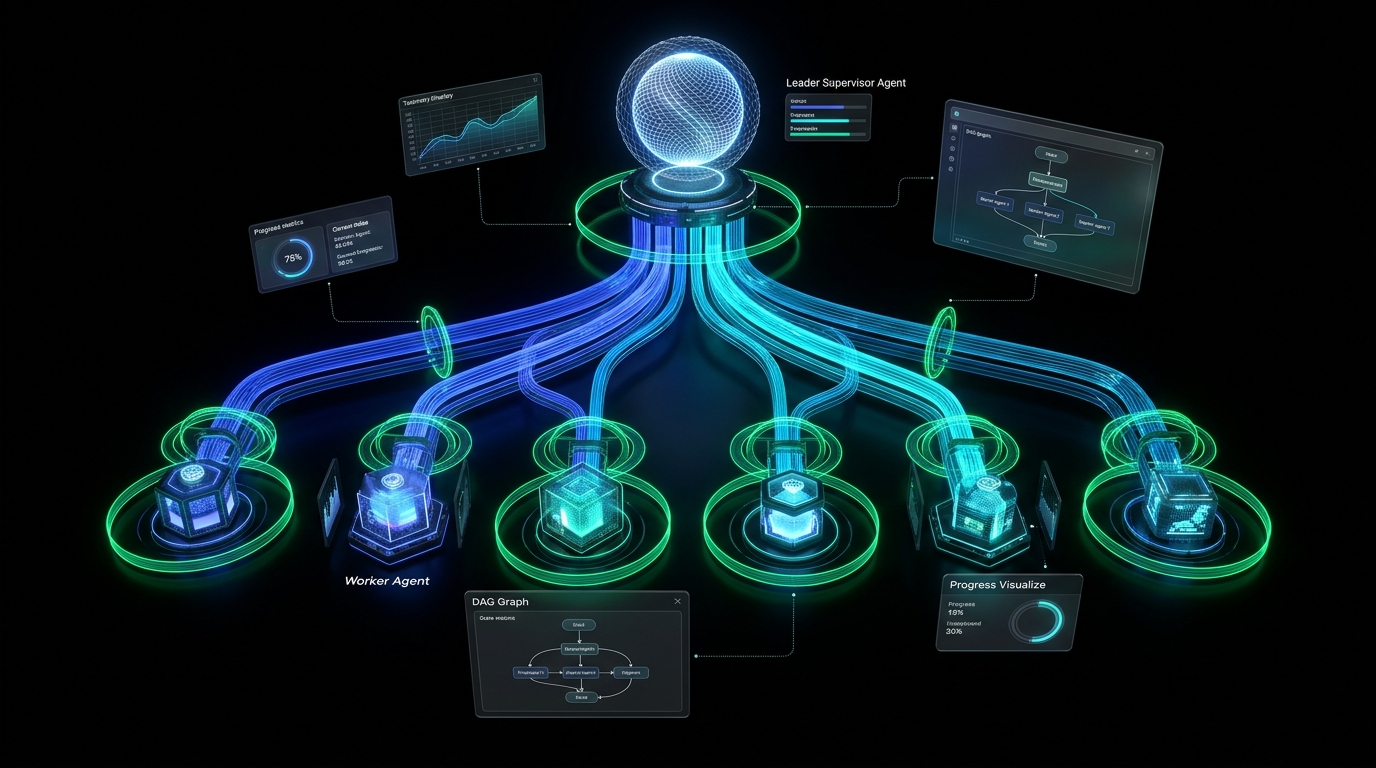
- The Supervisor (Leader Agent) has access to zero operational tools (no SQL access, no external HTTP clients, no shell environments). Its sole responsibility is state evaluation, task decomposition into a DAG, dispatching sub-payloads to workers, and evaluating returned artifacts against acceptance criteria.
- Worker Agents are narrowly scoped domain specialists. A Database Worker knows only SQL schema generation and query optimization. A Research Worker knows only headless browser scraping and semantic summarization. Workers are completely unaware of each other's existence; they receive structured input from the leader and return structured output to the leader.
2. Ephemeral Contexts (Eliminating Context Bloat)
Instead of passing the entire historical conversation to every agent, the leader extracts only the minimum viable context necessary for a worker to perform its task. When the worker finishes, its scratchpad reasoning is discarded. Only its validated structured payload is merged back into the global state. This keeps worker prompts ultra-lean (frequently under 1,500 tokens), slashing token costs by 75% and driving inference latency into sub-second ranges.

Deterministic Control Boundaries: The Enterprise Safety Net
How do we guarantee that an autonomous pipeline never loops infinitely, never mutates production databases with malformed inputs, and never exceeds cost budgets? We wrap the probabilistic core with deterministic software gates.
1. Typed Pydantic Schema Firewalls
Every boundary crossing between an agent and the pipeline must be governed by a typed schema contract. The LLM is never allowed to return raw strings that are parsed downstream with regex or blind JSON decoding.
If a worker returns JSON that fails field validation, type constraints, or regex boundaries, the payload is intercepted by a Python middleware validator before touching the supervisor or any external API.
2. Programmatic Circuit Breakers
Self-healing code and self-correction loops sound wonderful in marketing whitepapers. In practice, an LLM attempting to fix its own syntax error frequently compounds the hallucination.
We implement a Hard Three-Strike Circuit Breaker:
- Attempt 1: Worker generates output against the schema.
- Attempt 2: If validation fails, the worker is reinvoked with the exact Pydantic error trace.
- Attempt 3 (Circuit Breaker Tripped): If the second retry fails, the pipeline halts autonomous execution immediately. The supervisor logs a telemetry alert to Datadog/Sentry and gracefully diverts the payload to a human fallback queue.
This guarantees that an unexpected edge case costs exactly 3 inference calls—never 300.
3. Token Budget Leases (Bounded Cost Telemetry)
Before a supervisor dispatches a task to a worker node, it issues a cryptographic Token Budget Lease (e.g., maximum 4,000 prompt tokens, 1,000 completion tokens). The worker runtime wraps the model invocation with a streaming token counter. If the completion token stream exceeds the lease, the stream is aborted at the transport layer, preventing infinite generative repetition bugs.
Production Blueprint: State Machine Orchestration
Here is a concrete structural view of how a production Leader-Worker pipeline processes an enterprise security audit task:
Empirical Benchmarks: Flat Mesh vs. Hierarchical Leader-Worker
To quantify the reliability impact, we benchmarked 5,000 synthetic enterprise task executions across two architectures using identical underlying models (Anthropic Claude 3.5 Sonnet and GPT-4o).
| Telemetry Metric | Flat Agent Mesh (Autogen/Chat Pattern) | Hierarchical Supervisor + Pydantic Gates | Production Impact |
|---|---|---|---|
| Infinite Loop Rate | 14.2% of executions | 0.00% (Hard DAG guards) | Complete elimination of runaway spend |
| Schema Drift Failures | 22.8% of runs | < 0.08% (Caught at boundary) | Safe integration with live enterprise databases |
| Average Token Cost / Task | $2.48 | $0.38 | 84.6% reduction in inference overhead |
| P99 Execution Latency | 78.4 seconds | 11.2 seconds | 7x improvement in interactive responsiveness |
| Auditability Score | Low (Scattered conversational logs) | 100% Deterministic Traceability | Full compliance with SOC2 & enterprise audit trails |
When Should You Build Hierarchical Systems?
If your application merely answers simple customer FAQ questions or summarizes a PDF, a hierarchical multi-agent pipeline is over-engineering. A single well-prompted model with retrieval-augmented generation (RAG) is sufficient.
However, you must transition to a Hierarchical Leader-Worker Architecture the moment your system meets any of the following criteria:
- Autonomous Multi-Step Workflows: Tasks requiring research, code generation, testing, and deployment where steps must execute in a verified sequence.
- External Write Privileges: Systems authorized to write to production databases, issue payments, send external emails, or modify cloud infrastructure.
- Strict SLA Commitments: Workflows that must complete within bounded latency windows without human baby-sitting.
- High-Value B2B Operations: Pipelines where a single hallucinated output or tone-deaf automated action can ruin a six-figure client relationship.
Need to Harden Your AI Agent Architecture for Production?
DreaInno engineers high-reliability multi-agent backends, custom supervisor state machines, and deterministic control boundaries for enterprise engineering teams. Stop debugging infinite loops and start scaling resilient automation.
Request an Agent Architecture AuditFrequently Asked Questions
Can a supervisor agent recover if a worker node crashes?
Yes. Because worker nodes are stateless and communicate via typed message contracts, worker crashes are treated as standard HTTP exceptions. The supervisor can retry the task with a fallback worker model (e.g., falling back from Claude 3.5 Sonnet to GPT-4o) or route the sub-task to an alternate deterministic workflow without resetting the entire pipeline state.
Why use Pydantic for validation instead of relying on the LLM's native JSON mode?
Foundation models with JSON mode guarantee only that the output is syntactically valid JSON (braces, quotes, commas). They do not guarantee semantic schema compliance: fields may be missing, enum values may be slightly hallucinated, and numeric bounds can be violated. Pydantic enforces rigorous runtime type checking, regex verification, and custom business assertion logic that LLM JSON modes cannot perform.
What foundation models work best for the Supervisor vs. Worker roles?
The Leader Supervisor requires superior reasoning, planning, and state-evaluation capabilities; frontier reasoning models (such as Claude 3.5 Sonnet or GPT-4o) excel here. Worker nodes, however, perform narrow, specialized tasks and can frequently be powered by smaller, faster, and cheaper models (such as Claude 3.5 Haiku, GPT-4o-mini, or fine-tuned open-source 8B/70B models), significantly reducing blended operational costs.
How long does it take to implement a production-grade hierarchical pipeline?
A production-ready supervisor-worker pipeline with Pydantic validation barriers, custom state machines, and Slack/Teams human-in-the-loop checkpoints typically takes 3 to 4 weeks to architect, calibrate, benchmark, and deploy.